Friday, December 30, 2022

Bequeath - invaluable of otherwise valueless

 I have no real memories with him, for my journey with him had begun long after he was gone. And so I was literally left with his ‘left overs’ at home – things he left behind which have not yet faded or depreciated by then.


That  was probably one of the most confusing phases of my life, for that matter, any child’s life. I am referring to that tender age which finds it difficult to differentiate between dream and reality, and naturally forms a continuum of the two. Probably I was just picking the language, understanding some words in their right connotation and interpreting some others attaching my own meaning to them. I would hear some things, see some other things and connect them to make my own story. That was not the confusing part. The confusing part was when I used to fail to differentiate between the story I weaved and the reality. 

The fact that I am writing about it now, indicates that I still remember some of those images vividly. They have become part of my permanent memory, though I wont now narrate them to others as part of my real childhood stories, but they have become inseparable part of my childhood memories and experiences. That tender confusing phase of my childhood coincided with one of the most challenging phases of my immediate and extended family. I am sure the grownups in my family had no such confusion running in their heads, though they might have taken their own time and chosen their own path, to accept the unbelievable reality – sudden loss of a dear family member at a very young age. 

One can imagine how excited a child would be to hear the word “train”. I was too, but the fact that I always used to hear it in the same sentence with the word “accident”, made me sense the sadness in the air. In addition, faces I used to see everyday at home hardly appeared among the photographs on the wall. They were mostly of only those persons whom I never encountered at home. Fortunately, elders have a way of letting kids know of the stuff they are supposed to know and make them oblivious of those they think they aren’t supposed to know. Often I was asked to identify the man in those photographs, whom I have learnt to address as “Daddy”. 

With time, I have picked some facts, stories, interests and other stuff about The Man. I used to spend most of my time at home in the very room and house he used to spend. Though certain things were kept hidden intentionally – a video in which he appeared, his clothes and other belongings – not everything which ever belonged to him could be kept away from me. Once a person moves on from this world, some of his or her belongings fade away quickly than others. Some things we try to preserve and hence stay for a long time, but eventually they too disappear. Nevertheless, those things would become part of the memories left behind by that person. But in my case, I have no real memories with him, for my journey with him had begun long after he was gone. And so I was literally left with his ‘left overs’ at home – things he left behind which have not yet faded or depreciated by then. 

Give a child valuable articles worthy of display in a museum, they would just be mere toys and he or she will happily play with them. I was doing the same with the ‘left overs’ too and never realized back then how much impact they would be having on me and my personality. The fact that I am writing about it after three decades says it all. This connection between these two disjointed worlds – one a child’s world which was trying to make sense of so much beyond its capability and two what was once a man’s world, now left behind as he moved on from there – began in a small room fondly called as “balcony” by the family, for it must have been a balcony overseeing the road below before it was  turned into a small room for my parents. 

That balcony room had become my go-to place. It was like a debriefing room where in I would think, analyze and make sense of what used to happen outside it. It was where I used to connect some dots let lose by elders at home. It was where clarity and confusion would debrief each other and it was also where the lines between dream and reality were blurred. One such blurry picture deeply imprinted in my mind was an instance where I was walking behind my mom in that small balcony room and I could sense someone in waiting in the corner of the room. My mom walked past them as if there was no one. I dared to turn and was shocked to find the Man in the photo on the wall sitting on his knees in the corner of the room, gesturing me to approach him and I was petrified and did not dare to move an inch. 
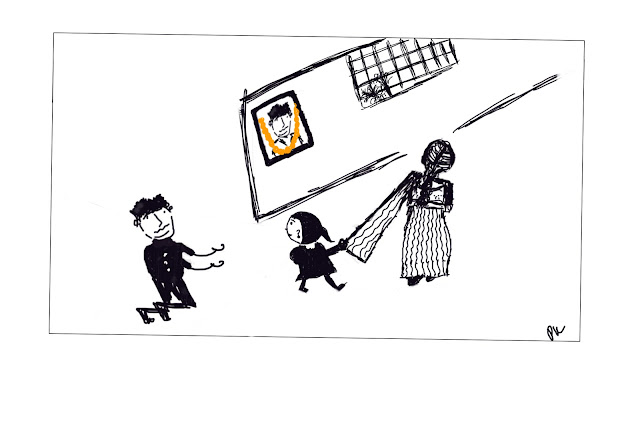
First time every drew something from imagination .. pls bear :)

Other such real-like-dreamy images included the instances where I kissed him goodbye before he left home on his last successful journey and the one where he had come to pick me up from school. The former would or wouldn’t have happened but the latter definitely did not happen. Amidst this confusion, the tangible left-overs are  the ones which grounded me. His abode – the balcony room – was like a clueless treasure hunt arena for me. The more I dug the more I found – both his self and my self. The morning sun light used to brighten up the little room so much that it used to overflow from its windows as if the room itself was the source of light and not the sun. In that brightness a dancing doll (butta bomma) which was an assembly of loose parts each of them on the verge of falling apart but would never miss a beat to little nudges we used to give with our fingers. 

How much ever small a room might be, a small dedicated work space say a table would detach the mind from its noisy surroundings ensuring complete concentration if the sitter at the table wished for. His table with a lamp on it, two draws – one of them always locked, a round iron stool with loosened broken wiring, with some books on it – was an adventure land I used to find myself lost in. Things behind locked doors excites us a lot, more so for children. When I developed the intelligence to find the key, open it secretly to see what’s inside, my child self was super excited to see packs of pencils and erasers. That was the first and last time in my childhood, to have seen a full pack of pencils and erasers being brought home. Clearly, the way he planned for his school going kids – my brothers – was not the same as was planned by others for me. Though that left a vacuum in me, never uttered a word about it for want of right language, right time and right people and cause of a deep determination within me to never ever start expressing a feeling starting with the phrase – “had he been there….”.

Rarely it so used to happen that I hit the sack and I fall asleep immediately. During those lonely musing times in between wakefulness and sleep, my eyes always used to fall on a lovely lantern with a bed lamp inside. A greenish tinged light used to brilliantly find its way out of a meshy surface. The lantern’s handle otherwise used to hold it by hand, was hung on to the ceiling, as if an invisible hand was showering the dimmed light onto the sleepers. Another such thing which used to evoke musings in my child-self was a sunset silhouette painting - with bright reds and yellows, water, a tree, a boat, a man on it - which I found has become a commonplace over the years. 

As I tickle my memory I recall many such objects – the left overs, which have left a deep mark on my consciousness. Non academic books like a dictionary, a book on short hand, a writing plank; an old camera with a nice leather cover, wall full of photographs – not just any but his own photos with special effects like multiple pictures in one, he shaking hands with his own self (imagine this was in 70s and 80s); well carved wooden items including a pencil box, a jewelry box which are still widely available in Telugu states’ government emporiums; a zipper file to safely store documents; a guitar etc. These are only a few of the things I could recall. 

Among them all, one that had left much deeper an impact was his interest in movies and the medium through which they can reach people. He made that his livelihood (A shop to rent video cassettes and equipment to people) and had left behind tons of video cassettes – the good old magnetic tapes, if you know, those black ones with two white tape guides and a title label stuck on one of its sides. They were all full of movies, video songs etc. Not that I watched and enjoyed all of them but it did introduce me to the world of art, music, movie and much more. Movies – with their varied characters, stories, insightful dialogues, impactful song lyrics – have taught me life lessons. His collection of Charlie Chaplin and Laurel and Hardy from the silent film era left some dots loose which I have been connecting over years. Probably because of this early establishment of my connection with the movie world, it still remains special to me. I don’t just watch them but analyze, criticize, imbibe and inculcate. 

Now when I think about these thoughts over and over again, I see how those tangible left overs in combination with all the anecdotes I used to gather about him in my childhood, have left some deep marks. Many of my interests emanate from there, if not all. Though I am not wholly a product of them, a piece of them definitely exists in me. Just like we are what we think, we are also what we see and get inspired.  If not for those left-overs, what would have been my story? A non-existent person would have not existed for me. But with the left overs bequeathed to me, I was able to draw my own memories and inspiration, and was able to establish a connect between two different worlds. This was all probably a child’s way of dealing with the loss and fill the vacuum left behind, but I can confirm that it was a successful one. Had he been there, would the bequeath be any different from what I now imagine it to be? Probably. Who knows. 


Friday, May 22, 2020

D for Donkey.... D for Darkness...


The wonder was that it took thousands of miles of journey away from home, almost three decades of one’s life to learn that donkeys are not what we think they are, but something else too… 


There is a saying in Arabic which translates to – ‘seek knowledge even if you have to go as far as China’. Though its origin, meaning and context are debated upon, two things stood out for me. One, the distance one may/can/should travel in quest for knowledge. Two, the very search for knowledge. Meaning, the knowledge readily available at hand with us may or may not be true. And so, it is a constant search for knowledge which includes both learning and unlearning.

Today I am going to tell you a story which highlights the above two points. It is a travel story (distance) and it involves learning and unlearning (knowledge). Was I traveling in search of knowledge? No. I just happened to experience some things, the visuals of which are going to stay for quite a long time with me. And no points for guessing that the story has donkeys and darkness in it. J Remember those early days in your life where you had to repeat A for Apple, B for blah blah…. & D for Donkey… ?!?! I am sure you do.

Since the time I was introduced to a donkey, never heard an adult speak anything but ill of it. I have always heard it being used to refer to (ahem.. to scold) children and adolescents who are lazy, dull and slow; to mock down someone  for his or her donkey-like voice – braying, hee-haw, hee-haw; ‘Parading on a donkey’ is a humiliating and an insulting form of punishment across many cultures. Even in slightly positive sounding expression like ‘I’ve been working like a donkey’ the focus is on the unpleasant, menial, bone breaking hard work for long hours rather than on patience, endurance or for that matter anything remotely positive.

My story dates back to February 2018 (excuse the donkey in me, for procrastinating publishing this post for more than 2 years) during my visit to Petra, Jordan - one of the seven new wonders of the world. For those who can relate it is the very site in which Indiana Jones finds the Holy Grail in the film Indiana Jones and the Last Crusade. Located in between Red and Dead Seas, this vast red sandstone landscape is half-built and half-carved into the rock. It is surrounded by rocky textured mountains pervaded by passages and gorges (photo).


My husband and I had a flight to catch the next day and so all we were left to explore this vast place was just half a day. Though we were told it takes at least a day to explore important spots and a maximum of 3-4 days to see the place thoroughly, we were determined to tick off yet another wonder of the world and set out to make the most of the half-a-day we had. Reaching there hungry and tired after a 3-hour long drive by road from Amman (Capital of Jordan), we quickly hopped on to horses thinking they will give us a quick parade of the place. Shockingly the horses abandoned us right at the inside entrance beyond which they were not allowed.

After walking for quite a long distance exploring the narrow gorges, carved rocks, a roman theatre, sand art artifacts, temple on a hill and surveying the vast hilly red sandstone landscape, we knew that it was time to go as we were nearing the closing hours. But then, in a desperate attempt to see more in the short span remaining, I inquired from a fellow tourist about the one thing that is worth seeing and should not be missed for anything. He pointed towards a monastery located high up on a hill, the view from which will be breath-taking he said. But there is a caveat here, it usually takes 75 to 90 minutes to hike the hill by foot :/ which we didn’t have.

Just then, two men – Mahmoud and Adil (names changed) approached us claiming to be our saviors and breakers of our dilemma – to head ahead or to head back. They said “believe us .. we can take you up the hill on our donkeys and leave you at the exit in reasonable time”. I was taken over by FOMO (Fear of Missing out) not just the monastery and the view from there but most importantly the donkey ride. I was excited to take my first donkey ride, which was literally going to be a steep up-hill task. My husband was a little hesitant at first to take this long bumpy ride uphill fearing for our backs, fading light and the chances of us getting trapped behind closed doors. Nevertheless, he agreed and there we were on our first donkey rides.

There was a visible strong bond and a deep understanding between Mahmoud and Adil.  They knew each other for years. Mahmoud was more speak-your-heart kind of a person and Adil was let-silence-speak type. Both of them speak English so well. Not only English, they even picked up some Japanese (at least that was what they said they were speaking when they blabbered something in Japanese). The to-journey conversation was mostly trivial touristy talk. 

Thankfully, the donkeys didn’t seem to share such an affiliation for each other (at least at the outset) and so are not disturbed or distracted by their masters’ constant chitter chatter. At times, the masters even let the donkeys loose, we the ‘riders’ were worried especially when the donkeys tend to sway towards the edges of the pathway, by the sides of which were low lying areas. We were amazed by not just the agility with which the donkeys climbed the steps but also the strength of the lungs of the two masters who were all the while walking uphill along side the donkeys.

Finally, we reached a point on the hill beyond which donkeys weren’t allowed and we had to walk for a few minutes to reach the monastery and the viewpoint beyond it. We were the only two walking towards it while the rest of the tourists were heading back. We were hoping to get a good glimpse of the place while there was still some light. We managed to reach just on time panting, took a deep breath and enjoyed the breathtaking view. The cold winds blowing right into our faces swallowed the tiredness and exhaustion caused by the scorching heat of the day.

With a selfie break every now and then, engrossed in sharing our overwhelming joy for having made it this far in no time, we finally met Mahmoud and Adil at the same point where they left us earlier. They seemed cool and relaxed. Neither our delay in returning to the spot nor the fading light made any difference to them. Neither were we worried, as we were still stuck in the state of joyful inertia. 

But no sooner than we reached the foot of the hill, with hardly any light left (no sun, no moon, no street lighting, no mobile torch… ) to guide us through, the elephant in the room – the darkness – became more visible. It engulfed the vast lands of Petra. No longer can one distinguish between a mountain, a gorge, a cave, a rock .. It was all dark. A vast black blanket with no end and no beginning, unfolded in front of our eyes in seconds.

My husband and I switched to our mother tongue trying to give each other hope by assuring one another that these donkey masters must be carrying a small torch, to guide us till the exit. But we spoke too soon. Something very strange happened. Mahmoud hopped on the donkey I was sitting on and Adil on my husband’s. I was confused how to react. Should have waited and watched what happens? (Oh wait… what was there to watch, it was pitch dark) Should have asked him not to sit behind me?  Should have done this or that? But dumbstruck, all I did was, to say to my husband “Lets see where this goes… be ready for the worst”. That was how four blind people on two donkeys wandered the depths of darkness, with at least two of them unsure as to where they were headed.

For Mahmoud and Adil, it seemed like the most natural move, a business-as-usual.  For donkeys it did not make any difference except addition of a little more weight on their backs. You can imagine what all must have crossed the brains of the two strangers of the land. Never was I so blind in my homeland, even on pitch-black nights, for I could see a light of familiarity guiding me through unknown and uncertain circumstances. One thing was clear though, that Mahmoud and Adil were as blind as we both were and that the donkeys were the only torch bearers of the party.

I did not understand whether the donkeys could actually see the way, or they just remembered it ‘blindly’. I was awestruck by the skillfulness with which they were carrying us through the narrow gorges. There were times when my shoe would touch a side wall, and then I  groped with my hand to touch the side walls of the gorge we were passing through. That was it, that was the proof that the donkey truly knew where it was going. Yes, the donkeys were the only ones in that party, who knew the darkness, who saw through the darkness.

Mahmoud was equally talkative during our return journey, but something made him to dive into deep emotional conversations. Maybe it is the physical distance between us or just that the darkness made his invisible mask (which we all wear on our faces and hearts) to disappear. He talked about his family, his struggles, his father’s demise, how it left a vacuum in his heart, how they like sneaking into Petra and party under the moonlight ..so  on and so forth.

Within a few minutes we could literally see the light at the end of the dark tunnel through which we were passing through. As we bid farewell to the two masters and their donkeys at the exit gate, and started walking away, the pieces of puzzle seem to have fallen in place. It seemed as if our unplanned, unintentional travel to distant lands finally found its purpose and meaning. 

Wonders of the world may seem majestic, gigantic, and vast but true wonders lie in the lives of Mahmoud and Adil-likes who epitomized honesty, hard work, smartness, curiosity, compassion, and innocence. The wonder was that it took thousands of miles of journey away from home, almost three decades of one’s life to learn that donkeys are not what we think they are, but something else too… The imprint those donkeys left on me was not that of their screeching sounds, not their laziness, not even their menial mindless work but an impression of a smart ass..! Right now at this very moment, a smart ass might be sitting near you and you may be blind with prejudice to identity him or her… Go find those donkeys who can guide you through your darkness....  

Friday, June 7, 2019

The Ant in the room


Ant to an elephant running towards him: what happened?
Elephant: A hunter is chasing me..
Ant: come hide behind me !!!!!!!!!!!!!!!!!!

The ant and the elephant duo – be it in the story or in jokes like above – never stops fascinating me. The charm lies not only in the fact that two beings on the extreme ends of size spectrum are brought together but also in the mind-boggling way in which the ant always punches above its weight.  The most underestimated of the two turns out to be the saviour, the hero, the smart and the courageous one.

The duo challenges our stereotypical way of labelling someone strong or weak based on irrelevant attributes like appearance, size, voice, participation, confidence levels, body language etc. I like the fact that this duo is used to disprove the strong connection we tend to establish between what we see, how we perceive what we see and what it is. A closer look will tell us that all three are separate phenomenon.

The elephant in the room needs no introduction. It escapes no eye. Even its silence is heard loud and clear in our minds. On the other hand, a pinch of ant’s presence is felt only after it puts its life itself at risk. Yet we equate ant with slow, weak, tiny and voiceless and nothing compared to an elephant. We do have among us elephants, ants and those personalities who lie between these two extremes. Of course, we may also encounter elephants in the garb of an ant and vice versa.

Children are usually the victims of elephantine elders. They are highly underestimated when it comes to understanding “certain elderly stuff”. They are not meant to be part of certain discussions because the elephants in the room get to decide whether their ant brains are capable enough to grasp or not.  If you had such experiences as a child, you might have heard these expressions a lot “Go out and play .. this doesn’t concern you”; “go inside … right now” …. And fortunately or unfortunately if you happen to have got everything what was happening and opened your mouth, there comes the ultimate weapon – “you are still young.. you are just a child …. You don’t understand …. Keep quiet”.

For parents, no matter how much their children grow, they remain children still. No wonder my mother still says that am too young to understand certain social pressures. Obviously, the age of parents and the experience that comes with it is what is making them feel that they are elephants and ignore the ants in the room. But as the saying goes - what goes around comes around – in the parents-children duo soon role reversal happens over time. The changing times, technology, differences in life styles and many other factors contribute in making the same children elephants and the parents ants.

Children and parents duo is just one example out of thousands of such scenarios across cultures and geographies, where ants in the room are not paid heed to. Small states vs big states, developing vs developed, male vs female, male and female vs lgbtqi, rural vs urban, old vs young, north vs south, east vs west, white vs black, tribal vs non tribal are a few more instances.

Elephants are made elephants because of the huge baggage they carry. That could be because of various factors like physical characteristics, age, experience, knowledge, resources, gender, religion, number, race, caste, colour, economic status, political clout so on and so forth. If we try and remove each of these imaginary layers, may be… may be what will remain in the core of an elephantine personality is no stronger than that of a mere ant. But it is almost next to impossible to convince our own eyes and trick our minds to believe that an elephant could also be an ant and vice versa.

Yet it is not impossible. We just have to change the frame of reference. Why expect an ant to uproot a tree? We have elephants to do that. Ask an ant how to be resourceful and organised. Ask an ant how to plan for the hard times. Learn from an ant how to be part of a team. Listen to its stories from the untraveled lands. Ants are everywhere in large numbers. Find out from them how they cater to huge populations. Learn from them disaster management tactics. They bring a lot to the table. All the while they might be having just the right answers with them.  Ensure to ask the right questions. After all it is equally impossible for an elephant to stoop too low to get ‘an ant’s view’. 

            The elephant in the room is what everyone knows about but not talk about while the ant in the room is what everyone wonders about, but no one knows about. The ant … the one any eye can easily miss, the one whose life is like a tightrope walk, the one which hardly a few stoops down to observe, the one who is usually too engrossed in every day survival struggles, the one who is too busy walking in long queues to gather food, the one who struggled to overcome its weaknesses, the one who strived to leave much bigger a mark behind than its own size … that ant, made it to the room … the same room as the mighty elephant. THE ANT made it to the room. Period. THE ANT made it to THE ROOM. Period. The ant is in the room. And the ant in the room needs to be heard. It has a lot to say….. and we have a lot to learn from the ant in the room ...

  
Two ants in conversation
Ant 1: look !! elephant is approaching.... lets attack
And 2: Uffooo ! forget it…. We outnumber him …


Sunday, December 3, 2017

A story of the sea, the shore and shells... (in Telugu)


A story... it could be yours or theirs or ours ... 
But for now, the idea shall reach those who can read and understand telugu..
I promise a translation of the idea into English sometime in the future.. 


Picture and hand writing credits: Aditya 


Sunday, November 13, 2016

Can we dare to pause???

Pause is that which reveals the grey areas, which makes the contrasts more visible, which wakes one up or puts one to sleep. It is a stepping stone for one who wants to rise up and that which holds one from falling down.


Do you remember those days when tape recorders used to have forward, rewind, stop, record, play and pause buttons. Applying these functions to life in this information era it is clear that we no more have control over what we can choose to play, nor stop ourselves from hearing to what is being played around. Neither every rewind gives us the same record nor every prediction of forward times the same. We could record things as they are happening, but no guarantee that they will remain the same the next minute in these dynamically changing times. I think the only control we have in our hands is the “pause” button.

When the months of November or December seem like midyear; or when last weekend just seem like yesterday while tomorrow is the next weekend already; When you feel that your two month baby in no time started going to kindergarten; when your bank account balance suddenly seems too less than you expected it to be; when your birthday this year seems to have come too soon; or when everything seems to be going wrong; or when we don’t seem to have any clue of what are the start and end points of something; each of these is an illusion caused due to lack of enough pauses.

Pause is that which reveals the grey areas, which makes the contrasts more visible, which wakes one up or puts one to sleep. It is a stepping stone for one who wants to rise up and that which holds one from falling down. It is a time for review. It is a time for a new plan. It is the time to see where we came from and the time to decide the direction in which to proceed.  Pause is a time when one should go deaf only to hear one’s self more clearly. It is a moment where one should go blind only to enable oneself to see new things or to see same things differently. Pause is a pause to past regrets and a stop to future regrets.

We might not always need new rules or new laws for old and new problems. What if in the first place we didn’t identify the problems rightly? We need not always run to reach our goal. What if our goal itself is wrong? We need not always follow someone just because there was only one track. What if it doesn’t take us anywhere? What if at any point the only way out is to pause? But I think we humans somehow do not have the skill to pause or at the least the ability to think of pausing. May be no one told us that to pause is an action in itself. Our failure to pause when the time is still ripe might never let us to take a pause even if the situation demands. Does this strike any bell? Don’t you think our problem of pollution and the lack of solutions for it is a consequence of our failure to pause?   

Do you think I am saying that we should put a stop to all the development and go back to the dark ages or that by pausing I mean inaction or idleness? No, not at all. Lighting a candle and then leaving it to fight with the wind before it gets blown off is stupidity. But taking a pause to make arrangements to protect the flame before lighting the candle is wisdom. We all read the ‘the hare and the tortoise’ story and we also know the moral by heart ‘slow and steady wins the race’ yet we almost always follow the hare. I wonder why !!! Should we mistake tortoise’s steadiness to be idleness or we should think that it kept gathering its strength for a longer journey ahead by taking enough pauses?


In a world where uncertainty is the only guarantee, where the unknown unknowns (in the words of Donald Rumsfeld) rule over the known knowns, sometimes a pause is a better solution than any action. As the world is getting smaller and smaller the butterfly effect will be more intense. I can pin point instances from our day to day lives to world politics where a simple pause would have made our personal and universal worlds a better place to live in. But I don’t want to. 

I only want to highlight the fact that a pause could be as small as taking time off a busy schedule to take a deep breath or as striking as questioning something before believing. It could be an effort to break a ritual or a stigma to offer alternative narratives or it could be as big a deal as taking a pause before starting a war. I just want to inculcate the idea of pause, emphasize its need and power. Let us take a pause and see !!!

Saturday, May 7, 2016

Draupadi - Devil or a Darling ?


In a society where honour was and is seen as the utmost important thing a woman should live or die for, what wrong is it if Draupadi pulls the string to the extent of a war.

It so happened while driving on busy roads of Delhi that my driver (trainer) mentioned about "women"driving. "It's all because of these women. They drive as they wish, rushing madly through the gaps". Whenever he made this comment, he almost always immediately (came very naturally to him as if it was hardwired in his brain) passed another comment on women, saying - "wars were fought 'for' women and 'because'of women. Many empires fell cause of them. You see, in Ramayana it was Sita and in Mahabharat it was Draupadi." Oh, it didn't shock me as that wasn't the first time I heard such an opinion. It comes naturally to an average Indian mind (both male and female). May be it is in the way in which the stories from epics were told. Or may be it is the most easiest way to understand a situation, conveniently ignoring various nuances in the story.

Two things to note here are - one,  tales from epic like Mahabharat tuned our opinions in a particular way. Two, it almost always taken for certain that an alternative view cannot exist. But what surprises me is neither of the two. Though Draupadi did fight to uphold her honour and avenge injustice, how the society managed to propagate the wrong message for centuries. Instead of appreciating her character for giving a tough fight, she has been accused as being the main driving force for the war. 

In a society where honour was and is seen as the utmost important thing a woman should live or die for, what wrong is it if Draupadi pulls the string to the extent of a war. Also, it is not that simple. There were multiple characters, varied vested interests, power struggles, ego clashes, fight for name and fame, etc which played a role in the final war. Why did we give a clean chit to all other characters?

Why is that the greatest warrior of the times, and the man of his word, Bhishm usually not accused to have let many misdeeds happen right under his nose. In the guise of guarding his vow, to protect the throne of Hastinapur, or for reasons unknown he never stood by Draupadi. What message is Acharya Drona giving us, who spent more than half his life avenging against King Drupad. May be he is telling us how ego should be pursued at any cost. The writer of the epic himself, Vyasa, seemed to have lost the plot somewhere as he failed to convey the message that the insult hurled at Draupadi is unacceptable. The blind king, Drutarashtra, is the culprit behind power and money struggles in many of the Indian families till date. He should be blamed to have not accepted his fate and for not being just with his brother's sons.

Why don't an average Indian naturally tend to accuse Karna for being a mute spectator during Draupadi vastraharan, and during Abhimanyu's death in the Padmavyuh? We only remember him for his loyalty, selflessness and sacrifice. Most importantly Pandavas themselves are not usually accused for their faults. Yudhistir, Dharam Raj, should have been ideally blamed for setting a trend for all those drunkards, gamblers and wife beaters (They might be honest to the core when sober). And his brothers, are more known to be loyal followers of elder brother rather than as those who forgone their wife's honour and self respect. Finally, the Lord Shri Krishn, a very close friend of Draupadi, portrayed as the sole protector of her, also tried to pacify Draupadi at various stages in order to convince her to cool down.

As we get into the nitty gritties of the story, there is no end to this blame game. No character is perfect. The so called Lord Himself, Shri Krishn, should have been notorious for cheating in the war. I might have sounded so far as if Draupadi has got nothing to be blamed for. Wrong. She too has enough on her plate. She insulted Karna in her swayamvar, she laughed at Dhuryodhan when he slipped into an illusive water fountain in her Maya Sabha and never apologised for any of her deeds. She was known for her arrogance and stubbornness. She has both negatives and positives in her, just like any other character in the story. However, her character seems to have been made the victim of her own blemishes. I also believe that Kunti and Gandhari should also be accused of not standing by their daughter-in-law. They symbolise all those women who consciously or subconsciously are responsible for perpetuating patriarchy in the society.

While on the one hand, Draupadi's honour was at stake and on the other none in her close circles seem to be understanding her plait. I don't see what other options she had other than fighting all alone and by vowing a revenge. I personally experienced this phenomenon in many Indian families, where mothers discourage their daughters to let their hair loose, as it is believed that they bring in disgrace, dishonour and bad luck to the family (just as Draupadi did, when she vowed to let her hair loose till she avenges her insult). We should instead appreciate her for fighting in a male dominated society in many a ways. She was the only female character in the entire story, who has a male friend (Shri Krishn). She was the only one, again, to have dared to reveal her feelings for another male (towards Karna). She was far ahead of her times, in not just accepting polyandry (fivehusbands) but for striving to be what she really is, free and honest, in a cage like society.

My aim is not to find faults with each of the characters, no doubt they are all great in their own ways. My idea is two fold, one I am just trying to highlight how one sided, how biased our story telling has been. Just to enable the readers to appreciate my point better, I would like to draw parallels between Mahabharat story telling in our country and a recent phenomemon, an epic like series Game of Thrones. Almost every character in it is shown from more than one angle. It would let the audience think in various dimensions. Two, how stories heard and told over centuries, impact our every day life. This is just one story, there might be many more stories and characters propagating misconceptions in the society.  Just imagine where our society would have headed had Mahabharat started on the note - 'There lived a Princess Draupadi, stunned the world by being born unexpectedly in a yagna, but later realised to have born for a cause. Born to beat the stereotype in the society and to wage war against injustice'. We would never know ! 


Wednesday, March 30, 2016

am in Andaman !!!


            Sometimes the resistance from within to leave a place for another, can be so high that we tend to speak and think of only the negative things that might end up happening. Now I get the word, it is "inertia". I was in that state before leaving for Andaman and Nicobar for navy attachment (part of my training). Not that I don't like travelling it was just that the pull factors were more intense than push ones.

First three days are gone in "trying" to learn something and "trying" to find places and moments of joy just to keep myself going. High moments of the day used to be less than normal - which included some learning regarding Indian Navy, playing in the beach, a food for thought from a book etc. Just when my boredom was about to overtake me completely, my patience started to pay back. Everything has its own time and place. How could I even think of living those moments whose time hasn't come. On the last day of my visit, in retrospect I could definitely say I had my share of take aways from the Island.

First  such moment was on Havelock Island. There, Radhanagar Beach was one of the most beautiful and finest beaches I have ever been to. The sand is so smooth that one can run on it only to feel the cushion underneath one's feet. The water was so clear with a marvelous mix of shades of green with thin white foam. The waves though huge are soothing and melodious. There was no sign of a single stone or a rock on the site. At 12 in the noon there were hardly anyone else playing in the beach, but there were a couple of foreigners, sitting in the shade and enjoying the view.

My second high of the trip turned out to be the biggest learning I had through out it. This was when we visited an island called 'Baara Tanga' on the way to which one can get a chance to see a few Jarawas. Though it was not in our tour plan, I insisted that we should visit the place, to find first hand answers to many questions which have been lingering in my mind for so long. Since, my days in Kalahandi, where I worked closely with a few tribes, such questions frequented my mind, like - what is the ideal way to deal with the tribals and their development?, What is tribal "development" in the first place?, Is it "good" for tribals to be integrated into so called "main stream"? Who should be "responsible" and "accountable" for act effecting tribals in any way? .. so on.. and so forth...  This particular tussle in my mind deserves a new post (sooner, asap may be)

Till then, I can share my little experience during my passage through Jarawas Reserve Territory (JRT). We started off from Port Blair at 4:30 am in the morning in order to reach Jirkatang, a panchayat in southern Andaman. This itself was pricking my heart every now and then during the journey, as we "planned" for it.. planned to see co-humans living in their natural habitat, leading their lives as normally (more naturally than any of us from so called civilized society) as any of us. Is it that they live in a world different from mine or that they live differently in the same world I live in - cant say for sure what made me go there. From Jirkatang, a convoy with police in the front started as per scheduled time. Before setting off for this journey I did not expect anything nor imagine anything as to how the experience is going to be. But as the convoy started my imagination started going wild. This was mostly because we were told that Jarawas would be seen on both sides of the road we ride on, who come out of their houses. The convoy started and like a child moving his head along a with the motion of a moving pendulum, to and fro, I started moving my head left and right, left and right trying to "spot" Jarawas. 

I am not very proud of using the word "spot", but yes that was precisely what was happening there. Soon our driver said "there, on ur left, behind, one is sitting"..., I quickly turned but missed him. As we moved on, since the driver was not allowed to slow down his vehicle, he used to quickly tell us "there, there a bunch of them sitting" and when I turned slowly to my left.. there, they sat a family. A man, a woman and a child, the couple sitting with their backs leaned onto a slab and the child in between them. In that quick pass, I could see them for only a few seconds. In those few seconds, my eyes picked up three things - a greyish ash like colour smudged on pure black (their skin tone), a small piece of red cloth covering the essential body parts and the look in their eyes. 

The look in their eyes and the posture in which they sat, hinted a kind of "indifference and duty". I didn't understand why would any one sit like that as if in leisure on the side of a road with fast moving cars, with thick jungle on both the sides. My guilt has gone deeper and my curiosity higher by then. My curiosity was not to "spot" more but to know why why why, why would they come and sit there like that. As the car moved on, I kept my head still on left side alone and soon, a little inside behind a tree, there sat another group of men. This time, they were a little far off, but something unique I saw. A man in regular clothing and a different complexion, a non jarawa, was standing next to the jarawas group. Oh oh oh !!! There the chain of questions went on and on in my mind.. and instigated many thoughts in me. I do not know much neither about the jarawas nor the issues concerning them. Hope to update myself by my next post on the topic. 

The third moment was yet an other world, like my second one. Truly natural world, the marine life in the sea, when I got an opportunity to do open sea diving, close to North Bay Island. The experience was too good to be true. It was like finding oneself in the middle of colourful marine life in the movie Finding Nemo. Just that this time it was too good to be true. The site of beautiful small fishes, schools of large fish, live corals gives one not only an eye treat but also shows in a small way that we know nothing or very little about "other worlds". I feel incapable to put in words that amazing beauty which gave me immense inexplicable joy. One should experience it for oneself... 

So, it wasn't as bad after all? May be. It did leave me with questions, thoughts, feelings, ideas and what not... ! 

Tuesday, April 28, 2015

"NOTHING" EMPOWERS WOMEN

For years, these women have been someone's daughters, someone's sisters, someone's wives or someone's mothers. In the old age, suddenly they find themselves to be not under the care of or care about any of them. They are nothing now.

What do you call this - a delayed empowerment or a mere desperation? 

For the past eight to nine months, during my visits to various villages in Kalahandi district in Odisha, I observed an interesting phenomenon regarding elderly women. Be it in a group or individually, they seem to be more vocal about their 'rights and entitlements'. They are fearless, less apprehensive, outspoken and more 'rational'. The transformation from 'purely traditional' to 'somewhat rational' over time, might have been facilitated by a multitude of factors - both external and internal. 

I feel that the main reason behind this 'delayed empowerment' in elderly women is 'NOTHING'. Yes, "Nothing" empowers women. For years, these women have been someone's daughters, someone's sisters, someone's wives or someone's mothers. In the old age, suddenly they find themselves to be not under the care of or care about any of them. They are nothing now. They are forced to stand up and speak for themselves. If they don't, survival gets more and more tougher for them.

Firstly,  in that old age, lack of regular income, and inability to earn their living, force them to a 'desperation' to fight back. Secondly, the apprehension that haunted them through out their lives, as to what the society, their male counterparts would think or say seems to have disappeared in their final phase. Lastly, the fear of being socially stigmatized seems to have vanished totally in front of the old age desperation and the new-found strength in having no strings attached.  In the absence of all those who relied on them for "honour", I think these women are able to put traditions aside and act rationally. 
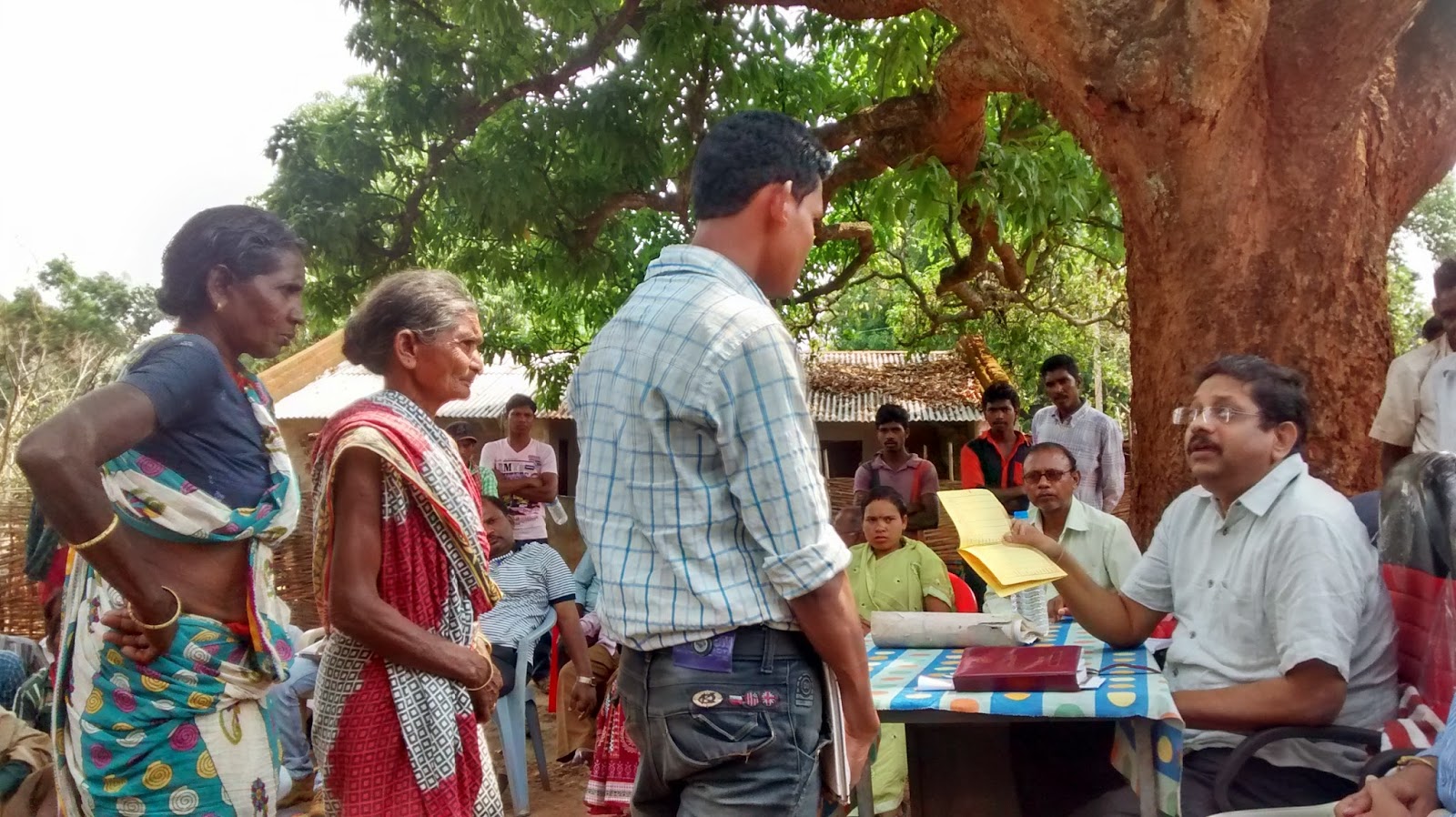
Around June 2014, in a huge block level gathering to review MNREGA scheme, I witnessed this woman, slowly yet steadily and boldly climbing onto the dais and dared to question the Block Development Officer (BDO) regarding some entitlement she was due to receive. 


In an another incident around September 2014, I attended a cluster level meeting where in representatives from various self help groups in that area were present. Even when a few young and middle aged women were shy and fearful to even say their names, an elderly woman sitting at the back was exceptionally overreaching. She seemed to have answers to all our questions and solutions to all the problems. 

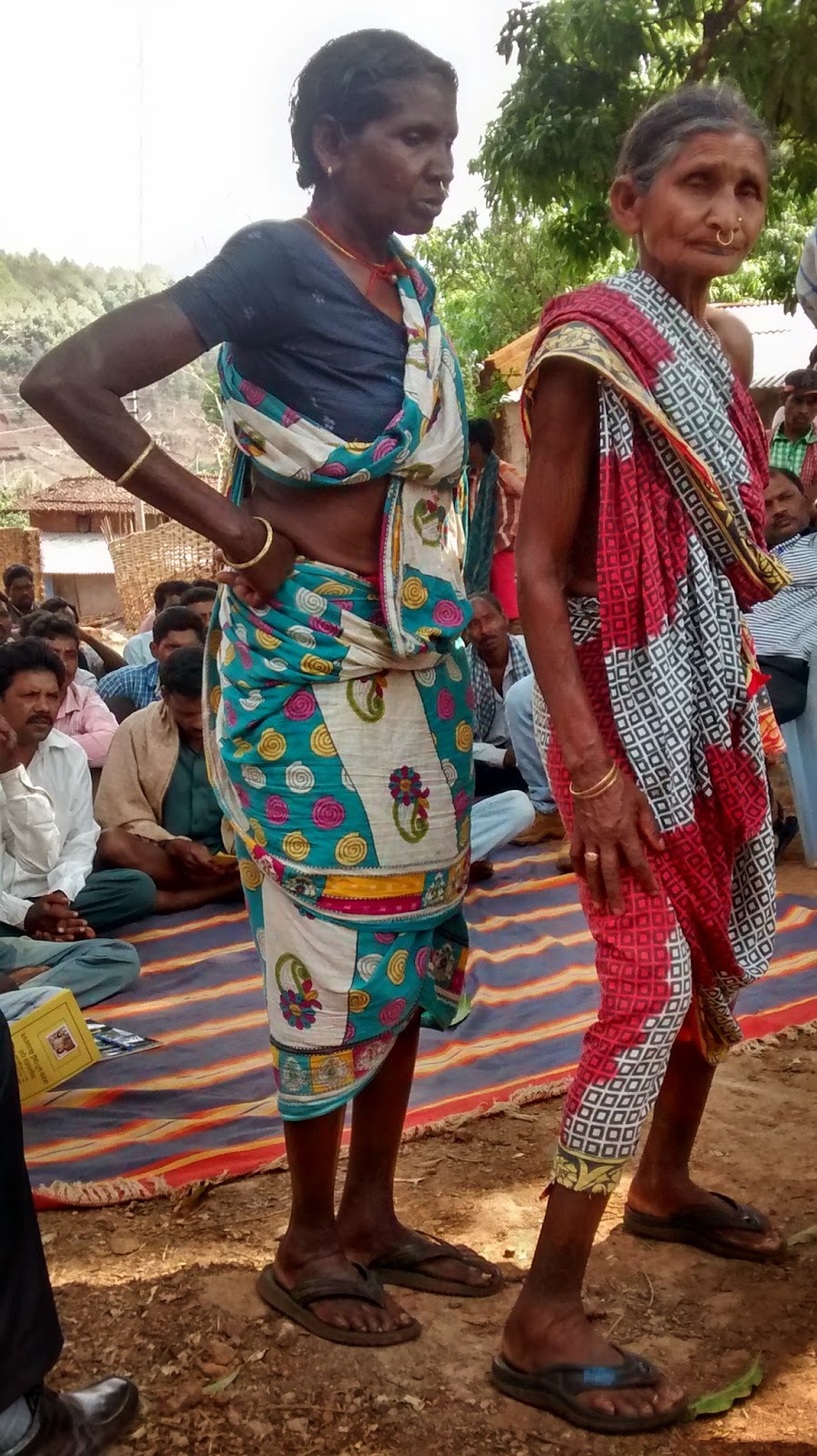
Very recently in April 2015, we conducted a gram panchayat level meeting, to find out about people's grievances. It was headed by Sub Collector of our district. Firstly, there were hardly any women attending that meeting. Secondly, even the young woman Sarpanch, did not speak a word. Then these two women walked in confidently and told the Sub Collector that they were not receiving pensions regularly. It might seem as a very small and trivial act for us. But when one tries to put oneself in their shoes, the context will be more clear. It is a big deal for the tribal women who would have hardly done such a thing before. It might be like a kindergarten child going to speak in front of an audience, for the first time.

What do you call this - a delayed empowerment or a mere desperation? I say, it is the both. They seem to be telling the society "We do not care for you and your stigmas anymore. We are free". And it is not a coincidence that all the cases I quoted are of widows and mostly from single women households. Yes, they are nothing. And I think - "Nothing empowers these women". This phenomenon finds further support in how the solar grandmothers are making the Barefoot College, Tilonia's efforts in solar energy training successful (Details here). You might have as well observed in your own grand mothers also, how liberal and rational they can get.

Skip this para if you are not a Game of Thrones follower :)
[To convey my point on "Nothing" more effectively I am borrowing an incident and a quote from George R R Martin's Game of Thrones. Samwell Tarly, a night's watch member, a coward at heart manages to kill a white walker and when inquired how he could do so, he replies - "I had to do something other wise Gilly (woman he was trying to save) and her baby would have been killed" (desperation). He further says - "I wasn't myself. I was nothing then. Nor son of someone or a friend of someone. When you are nothing, there is nothing to be afraid of" (Empowerment).]

This phenomenon shows how much the society is holding back women with unnecessary attachments, rules, conditions, restrictions and all the chains that do not let women take that much needed first step. Those who are able to break these shackles early, are able to stand up for themselves much in advance. Few of the rest do so much delayed at the fag end of their lives. The rest go unheard. 


Saturday, April 25, 2015

Happy yet guilty !!!


I could not digest the idea that the very weather which gave me so much joy and filled my void had forced some to commit suicide and created void in many lives.

It all started when I had one of the best evenings of my life, around ten days ago. I along with a friend, set out into the wild to explore nature in the rain. I was ‘literally’ on top of the world watching the hills change colours from lush green, to brownish to orangish. It was a treat to my eyes when the last rays of the Sun turned the hills to glittery gold. There seemed to be no end to my joy when I saw a rainbow for the first time in my life. Yet times when there was no sound other than that of breeze, water flowing, or birds chirping or my companion talking, there, at that moment, it seemed as if “it was everything”. I could feel the life oozing out within and outside, every second.

That conversation we had with the nature, and its beautiful replies filled the void in me that this mundane life keeps creating every now and then. That evening continued to linger in my thoughts giving me unfathomable joy, until … until… that moment of guilt stuck me. It was when I read in the newspapers that very week about the damage caused to the crops and loss to the farmers due to untimely rains. I could not digest the idea that the very weather which gave me so much joy and filled my void had forced some to commit suicide and created void in many lives.

While I continued to ponder upon this happy-go-guilty feeling, today another incident happened. A massive earth quake killed at least a hundred people in Nepal and tremors were felt across North India. One of my friends tweets me expressing joy and praising the day for giving him an opportunity to experience tremors for the first time in his life. I would have reacted the same had I been in his place. Nevertheless that happy-go-guilty feeling struck again. I am sure many of us have gone through such moments.  

When I ruminated on this idea, I could recall many such incidents from the past. I think we felt the same dilemma when we had to welcome 2005 new year after Tsunami in December 2004. Back in my home town, I remember people not wanting to celebrate Diwali after the cyclone Hudhud devastated the city of Vizag in Oct 2014. I also remember to have had an ounce of happiness that a war (Kargil) has happened during my life time, though felt sorry for the lives lost.

In all the above incidents there are certain commonalities. They are either natural or lie outside of one’s influence. May be if I had the power to stop a war or prevent a disaster I would do so, rather than enjoying or living the moment. On the contrary, I was never seemed to have been celebrating my helplessness, I think I was just living the moment. The best part of this feeling is my realization that what gives me pleasure is giving pain to someone else. There are and will be many more from which I continue to draw pleasure and don’t even realize that the same is painful to someone somewhere. Also, there is a deep social and geographical connection to this feeling. The guilt that follows the happiness is mostly confined towards people or places one is surrounded by or associated with. I hardly ever related this guilt to some happenings in the Middle East.


I neither have a great mind nor an imagination to assume that pain and pleasure get cancelled on this earth. But it seems so somehow!!! When we take a moment to think through such happy yet guilty moments, I hope it will only widen our thoughts, open our minds and will be able to treat more of ‘others’ as ‘significant others’ and ‘one of us’. 

Friday, April 10, 2015

Suffocate schools with inspiration !!!

In this 21st century, opportunities to learn are to be provided for rather than waiting for chance to work in one’s favour. Inspiration put in the air around will be inhaled no matter what, and will give excellent outcomes. 


Scouting for a skill or a talent is a herculean task. Various kinds of tests – objective, subjective, physical, interviews, group discussions etc – are conducted by schools/recruiters to identity right talent. Of course, these are not foolproof methods and so need to change with times and evolve gradually. What should precede scouting is our sincere effort to hone skills.

Such an effort essentially needs two things. One, believing that each one of us has some hidden skill or talent which needs a conducive environment, a little aid and guidance for it to be brought forth. Two, the individual should be given the freedom to experiment, make mistakes, learn and unlearn. I need no statistical evidence to state that our current education system is lacking in both.  

Any interest or skill is to be identified much early in a students’ life by making the process part of the curriculum. It will only make it difficult with passing time to tap that hidden potential unless they are lucky enough to get right opportunities at the right time in their life. But our education system seems to have taken the proverb “curiosity kills the cat” too seriously. So, we are killing the curiosity itself. A good learning environment would stoke curiosity not kill it.

We do not even know how many Tagores we are killing at the budding stage. Imagine had Rabindranath Tagore been deprived of all the excellent exposure, encounters with eminent personalities and his own father’s guidance, what would have happened? The world would have missed a great personality. He mastered in all the arts that were introduced to him through someone. And he found his own inspiration from nature.

On the other hand, consider Ambedkar’s story. In spite of the caste discrimination he faced as a child and his familial problems, he was lucky enough to get good opportunities to get educated. He was highly self motivated and became the first not only in his family but also in his community, to have pursued higher studies. He later became an inspiration for millions.

In both the above cases, two things mainly mattered. One, the kind of exposure and opportunities one had. Two, how well the individual had utilized the opportunity.  Not all those who are given the opportunity will be able to use it well. But provision of right opportunities and exposure is the first step in the long journey. Especially in this 21st century, opportunities to learn are to be provided for rather than waiting for chance to work in one’s favour.

So, who should ensure that students are exposed to right information, right opportunities to learn? It is the responsibility of family and schools. State cannot directly target families but they can motivate the parents only through schools. Even before that what should schools do to inculcate “learning” as a habit? It should not be by “asking” them to learn but by “inspiring” them to do so. What can inspire? The question is what not can inspire.

A book, a pen, a movie, a song, a talk, a walk, a chat, a meet, a toy, an animal, a bird, the nature, a game, a teacher, a problem, a leader, a story, a struggle, an innovation, a solution – will the list of those which can be inspiring ever end? NO. Institutions should use these to give positive strokes of inspiration to the students. That will inculcate a ‘culture of learning’. Any learning should be rewarded in an appropriate way, though the best way to do so is to put that learning to use. This will lead to more inspiration. Inspiration put in the air around will be inhaled no matter what, and will give excellent outcomes. 

For example, a reading club initiative in a school, where in children read and discuss a book, their opinions should be published along with photo in an annual magazine. Once in a while an exposure visit to a new place, an interaction with new people will definitely make students’ minds curious and enthusiastic to learn. A talent search period should be made part of school curriculum. Students should be given an opportunity to show case their talents, appreciated for and provided opportunities to further hone them.

Many private schools and organizations are already working on making the learning interesting, inspiring and lively through activity based learning and teaching techniques. It is not a difficult task for government to take an initiative to change the learning environment of every school. The first step is to start thinking in these lines and with sufficient will power it can definitely be implemented. Money should not matter when it comes to human resource development, which will have a long lasting impact on generations to come.


Saturday, March 28, 2015

Cricket fans parented Virat Kohli ???


Within moments after Virat Kohli got out in the India vs Australia semifinals match, social media was flooded with jokes about him, his ads and his personal life. Many started blaming Anushka and concluded that his relationship with her was the reason behind his bad performance. There were many reactions and counter reactions from all sections of the social media.

One of the jokes that went viral was regarding his ad which says “Virat, I want you here in 5 minutes”. These kinds of jokes  are common. Even in advertisement with Ranbir (Pepsi), when Virat asks “main kya karoon Aunty?”, he was told “Tu ad shad na kiya kar beta, apne game pe dhyan de”. It is all part of fun.

But somewhere the pun has crossed the sportive limits. Our society’s natural instincts came forth. As many in social media rightly pointed out, this episode shows our casual approach towards women. Majority of the men who go behind women, take no time in blaming them for anything wrong. Discredit is usually given very generously to them. But the point of this article is something else.

For me, this episode has brought out some other important issue – that of ‘parenting’. Indian parents in general underestimate the multi-tasking capability of their children. They think that any involvement in extracurricular activities will ruin student’s studies. They are also apprehensive about their kids having too many friends. This is one of the main reasons for very meager participation of children in sports and arts. (Though the situation is improving now, it is still a long way to go)

I believe that our reaction towards cricketers’ performances reflected similar kind of parental no confidence. We expect them to perform and for some reason if they did not, immediately we tend to blame on their extracurricular. If some player is getting married or just had a baby – we might not blame these situations for their under performance. Why so? - Because they are acceptable to our parents and the society in general. Also, parents create ‘end of the world’ and ‘do or die’ situations for kids sometimes and react violently if they fail. Similar was the reaction when Indian fans threw bottles, chappals at our players in 1996 world cup semis?

Ads, personal life, IPL and many others will definitely have an effect on the players but both positively and negatively. When fans relate to these only negatively, I feel they are trying to parent the players just the way they themselves were parented. Was that what happened with Virat? We had too high expectations from him in this series, failing which fans parented him in the typical Indian parents’ way. Didn’t they?


e-solutions -- Effective solutions ???

The Union government launched a new initiative, Twitter Samvad a few days ago to enable and keep the government-citizen conversation going. This government’s determination towards e-governance was evident in ‘Digital India’ initiative - to build infrastructure, deliver services electronically and spread digital literacy. Even the previous government and a few state governments enthusiastically took up e-delivery of certain services and grievance redressal through social media. Of course, we all should hope that a day would come soon where most people will have devices to click, know where to click and that the governments would only be a click away from citizens.

Definitely, this is an ambitious target and it is a huge transformation from the present. As of now, there is only around 20-25% internet penetration in the country. This is least of our problems. The transformation from traditional to digital poses two major challenges. First, newly built service delivery/grievance systems should only ease the processes instead of complicating them. Second, the implementing agencies should be ‘willing to’ and be ‘able to’ deliver electronically.

The both of these are very vital issues – system and personnel. IRCTC though made ticket booking easy, issues like server errors, peak hour traffic, tatkal booking made user’s life difficult. This gave way to many unauthorized agents, fraudsters who took advantage of the loopholes and looted both the government and the passengers. And, most of the implementing personnel are still e-illiterates. The systems being built are beyond their capacity to comprehend. They might be having basic knowledge, but definitely not problem solving ability.

In addition to these, there are two more issues that are prominent, rural-urban divide and side lining of traditional grievance redressal mechanisms. Rural urban divide not just with respect to infrastructure, e-literacy but the very kind of service delivery and grievances arising are very different for rural and urban. The recent initiatives of participatory governance (mygov, twitter samvad) and grievance redressal mechanisms caters only to that 20-25% who use internet. This too is required especially as internet users are increasing year on and expected to reach around 40-50% by 2050.

However, the rural India needs more customised approach, though technology can still play a major role. Bangalore electricity board, Police are very active on facebook and twitter to not only keep people in the loop but also for grievance redressal. Two things help smoothen grievance redressal process through social media. One, ease of access in raising the complaint as it is just a click away. Two, doing so in the presence of many co-users and officials improves transparency and gives strength to the complaint. Rural areas rate zero on ease of access indicator; and access to wider audience is also limited to the people around and local officials. This way, the overall power a village has is lesser compared to its urban counterpart. Also, the fear of losing access to goods and services takes over the urge to raise a grievance.

The opportunity and transaction costs for public participation in governance or in getting their grievances redressed are higher in rural compared to urban. Opportunity costs include – daily wages for wage labourers, a day’s work for agriculturists etc. Transaction costs include – transportation charges for repeated visits to public authorities, time spent and the fear of losing the delivery itself for any complaint would invite the wrath of local officials.

To bypass all these, e-initiatives would have worked to an extent at least in an ideal situation, where the required infrastructure is available and e-literacy levels are high. That is not the case though, not only in rural but in most of the urban areas. So, it would be wiser to work on other forms of improving service delivery and grievance redressal mechanisms than waiting for ideal e-situations to develop.

A single window grievance centre for all grievances in every gram panchayat should be a good thing to start with. The application form should be treated as a complaint-cum-RTI application. Hence, the complaint should get a reply for the grievance raised within 30 days like in RTI. This has two advantages. One, many who would not have heard of the powerful tool called RTI, can take advantage of it easily. Two, government-citizen interaction improves, time bound redressal is assured and accountability of public authorities towards people increases.

In many of our states, (and even Union government’s) legislations for time bound service delivery of goods and services were enacted. They all have either two or three tier appeal authorities – at district, state/centre. Even the first appeal and second appeal be allowed to be given at the GP level at the single window grievance cell. Only a single format form for all grievances will eliminate all confusions and let people utilise the opportunity and get services delivered. They may be given a receipt as in RTI and charged a minimum fee. On the question as to who should be running the grievance cell can be debated. Nevertheless, it should be an independent body with very less stakes in the day-to-day administration.

The process should be as simple as the one laid down by Supreme Court in case of a PIL. It said a postcard would suffice. Our huge postal network can come in handy in strengthening the grievance system. If the locality has sufficient levels of e-literacy or even otherwise, user friendly interactive kiosks which record the grievances instantly can be set up.


In this digital era where everything seems to be easy to be implemented in an e-way through technology, it is important to strengthen traditional ways of grievance redressal. Though PM is trying to take utmost use of the radio network and rejuvenate it, it has been a one-side affair so far. To get more inputs from people, setting up of community radios may be encouraged, which works the same way as a social media, (people generated content, shared across a community but specific to a geographic location) but without internet. This government managed to build a good narrative around ‘digitizing India’. Similar focus should be given to all weather grievance redressal at everyone’s doorstep – digital or non-digital. 

Monday, March 23, 2015

Should we cooperate or non-cooperate ?

Cooperation and non-cooperation are like two sides of the same coin, both are needed but only in the right contexts. The non-cooperation movement during 1920-22 led by Gandhi had not only played a significant role in Indian freedom struggle but also laid down some important principles for functioning of a democracy. In his June 22nd 1920 letter to the Viceroy, Gandhi had asserted the right recognised ‘from time immemorial of the subject to refuse to assist a ruler who misrules’.

The words ‘subject’, ‘assist’ and ‘misrule’ in this sentence need to be marked. Their meanings and interpretations in independent India are blurred. Firstly, we are not subjects anymore yet we need to answer the question as to whether we are citizens in the true sense. Secondly, in a democracy, we ourselves are responsible to choose our representatives (not rulers). Thus we no longer have to assist them but we cooperate. Thirdly, we do not have a consensus on what is misrule. What was misrule yesterday is taken to be genuine today.

A true democracy would give its citizens their due rights and entitlements and in turn, a true citizen would cooperate with the government in right doings and non-cooperate in the wrong ones. This would keep the misrule in check. Achieving this is not as simple as it sounds. It is an intricate web of cooperation and non-cooperation between the government and citizens, within government, within citizens etc.

Across these varied nexuses, abetting has become the norm and any kind of non-cooperation is strangled. Every effort is made to punish those who do not cooperate. First, the “rights” are given to people freely through legislation and then they are to be “bought” with bribe. There is a whole chain of cooperation starting from the beneficiary at the bottom to the highest official. The internal chain of co-operators also has external political, business links, which further complicate the web of nexuses.

At the slightest hint of non-cooperation, the entire web turns against as we have seen in the case of D.K.Ravi, Karnataka bureaucrat recently. In 2012, a 30-year-old IPS officer Narendra Kumar was crushed to death in MP for fighting the stone mining mafia. Another dedicated officer Satyendra Dubey was shot dead for exposing financial irregularities in golden quadrilateral project. These are only a few instances. Frequent transfers, political interventions are other tactics used to punish the ones who hinder the business as usual.

Non-cooperation not only in bureaucracy but outside of it too is treated equally brutally. Here again the organised cooperation among multiple stakeholders work against those who do not cooperate. RTI activists, who have been striving to make the system transparent and accountable, were either killed or ostracised. Recently, women’s rights activist Sunita Krishnan’s car was attacked after she uploaded rape videos to shame the rapists. Irom Sharmila’s, is another classic case, who is charged with an attempt to commit suicide for her non-cooperation through a 14 year long hunger strike.

So, it seems as a society we are failing to protect the honest and upright who raise their voice against wrong doings. On the other hand, we are getting more and more comfortable in cooperating where we should not be. Because of the complexities of the myriad rules and regulations, huge delays in the system, for all practical purposes we cooperate with bribe takers, the corrupt and the middle men. In getting a driving license or a passport or a train reservation there is more incentive to cooperate with the wrong to get things done.

As Gandhi said, it becomes our right to refuse the misrule but atleast in the short run, it goes against the one who refuses. The larger worry is that the society is slowly embracing and preferring to encourage the wrong than to non-cooperate with them. For instance, one of the reasons for prevailing of vote buying during elections, is ‘vote selling’. A voter is willing to take money and sell his vote away. I am not totally blaming the voter.  For him, may be it is better to accept whatever he gets now, as he is not sure what he would get after elections. But there are a section of voters who are opportunistic and so cooperate with the corrupt.

Both cooperation and non-cooperation are continuous processes, the former gives immediate returns and the latter long term ones. Encouraging the wrong once started, becomes a habit and gets imbibed in the culture, and makes it difficult to change the course later. Non-cooperation is a continuous struggle, at every level. It is so difficult that even someone of Gandhi’s stature was able to do it on a mass scale only once. Yet at individual level he never cooperated with what he truly believed to be wrong. The moments of mass actions do come, but come very rarely, at an appropriate time when things are conducive. Yet we should not underestimate the power of a few, who stand against the huge tide of organised and unwanted cooperation. As Margaret Mead said “Never believe that a few caring people can’t change the world. For indeed that’s all who ever have”.